29 Oct 2018

Horsehair Worms

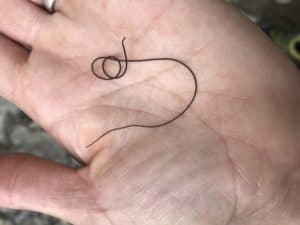
There’s something about long, thin worms that puts people on edge. Even I hesitated to pick up this little guy because of the fear of parasitic worms. Don’t worry, these horsehair worms (Gordius robustus) are not some parasitic nematode ready to crawl up your nose and take over your body. Well actually, I should clarify. You’re safe if you are a human. Even your pets are safe. However, if you’re an arthropod, you might be in trouble. The mature adults (like you see in the picture) aren’t the ones causing problems. It’s the babies you have to look out for, and you won’t even see them coming!

Adult females lay MILLIONS of eggs in the water. The minuscule (~0.01 inches) larvae are ingested by certain bugs for food. A hard covering (cyst) protects the larva, then dissolves after entering the gut of its host. Many macroinvertebrates become hosts because they live in aquatic habitats. Other common hosts are crickets, grasshoppers, and beetles because they eat macroinvertebrates, thus becoming the new host to the horsehair worm. As a horsehair worm develops into an adult over a few weeks or months, the host becomes the ‘walking dead’. Because adult horsehair worms require water to leave their host, the zombie host bug is triggered to find water, where it meets its demise. Most of us have seen witches melting from water in the Wizard of Oz, but here’s a new visual for you: death by worm breaking through a body cavity. And if you really want a good visual, search for horsehair worms on youtube. You’ll find all sorts of videos of them crawling out of crickets, spiders, cockroaches, and other arthropods. Maybe save it for Halloween.

One legend behind their name is that people believed the hairs from a horse’s mane or tail would fall into the water bucket and come to life. In reality, a cricket or host had hopped up to the water bucket, prompting a horsehair worm to break free in the water source. They are also referred to as Gordian worms because they twist and squirm into ‘Gordian knots’. In addition to having a very remarkable life cycle, horsehair worms are important for keeping our pest population in check. I encourage you to go on a hike and keep an eye out for any strange behavior from arthropods around water.

~Tracy

18 Oct 2018

Chilly mornings in the field

Today Jennifer and I got another early start to do some covey call counts and hopefully hear the coveys that our resident bird expert Joe heard a couple of days ago.  It was another clear and chilly morning and this time I was a little more prepared by bringing a fold up camp chair.  I found out that standing still in the middle of a field in 20 degree weather can be hard on your back! With a head lamp, chair, and a thermos of hot tea, we walked back to the same location where Joe was situated on our previous visit.  We still thought it would be a good idea to split up and go on opposite sides of the tree line, hoping we could better locate the direction in which the covey calls were coming from.  I kept looking at my cell phone to be prepared for when 7:14am approached so I could be extra focused.  7:14am came and went, then 7:29am.  Next thing I know, the sun is up.  Maybe Joe didn’t hear them…or maybe it’s just me?  When Jennifer and I met back at the tree line where we separated she excitedly said “did you hear them!?”  Nope.  Well…I guess it is me.  Next time we go to Lewis Township I’m sitting right where Jennifer and Joe were located so I can get in on the action too!  Good news is, Jennifer was pretty sure it was a covey call so we’re one step closer to confirming we have some quail populations.  And once again, as you can see in the picture, it was another beautiful early morning – a great way to start the day.

16 Oct 2018

Healthy Soil Holds Water

Healthy Soil Holds Water

In addition to testing the soil itself, we collect other types of information.  Water infiltration is a measure of how quickly 1 inch of water will enter the soil.  Metal rings are driven into the ground, water poured into the ring and the timer begins.  Without stable soil aggregates the pores collapse and water will not move into the soil.  Stable soil aggregates (produced by biology) maintain the pore structure and water moves into the soil.  Our newest property in Lewis Township (Brown County, OH) has historically been used for soybean crops.  Many of the areas tested there had standing water in the ring after 30 minutes.  In contrast, some of the pastures in Indian Hill had the inch of water move into the soil in less than 2 minutes.

Soil compaction is another measurement we make on our fields.  High soil compaction negatively impacts root growth and water infiltration.  A penetrometer is the tool we use to measure soil compaction. The tip of the penetrometer is pushed into the ground and the depth at which 300 psi is reached is recorded.  At the Lewis Township site that depth averaged between 11.4 to 16.8 inches.

01 Oct 2018

Looking for quail

During our time discussing quail habitat with our local Ohio Department of Wildlife agents we became curious if we could already have some quail populations at Greenacres Lewis Township.  Although the habitat is not perfect for quail currently, the property does have some good things going for it.  For instance, there are already “soft edges” around one of the large fields that we will be transitioning to NWSG pasture.  Soft edges means that the transition from open field to woods is gradual and not abrupt.  In other words, there are successional plant species between the field and the trees.  These plants species, such as briars and other woody shrubs are needed for cover for bobwhite populations to succeed.  Another promising fact is that Brown County (where the Lewis Township property is located) is one of the few counties in Ohio where Bobwhite quail populations have been surveyed recently.

One way to determine if we have quail currently is to do covey call counts.  This time of year the birds form coveys (small groups of 10-12) and about 45 minutes before sunrise they begin their “covey calls” to re-assemble from the previous night (click here for an audio clip).  To do call counts we need to be in the area of interest approximately an hour prior to sunrise.  From that location will not only count the calls when heard but also try to locate from what direction the calls are originating.  The next step would be to “flush” the coveys and count the birds as they fly up to escape.  This can either be done with trained bird dogs or we can try to locate and flush the coveys ourselves.